
Vacuum Infusion: Why It Matters for Fiberglass Boats

Matt McDonald • April 21, 2026

Fiberglass composites as we know them today first emerged in the early 1940s. Early technology relied on woven glass fabrics and infusion processes that are surprisingly similar to what is used today. As resin chemistries evolved and application equipment such as spray guns were developed, chopped glass fiber became prevalent. Open and spray molding

quickly became the dominant practice across the industry because large amounts of material could be applied very quickly.


Regulatory organizations like the EPA have continued to push composite fabricators toward closed molding processes such as infusion and resin transfer molding to reduce air emissions. Despite this, it remains uncommon for small boat production builders to update processes that have been in place for decades.

A Brief History of Fiberglass Composites

How Fiberglass Laminates Actually Work

In a fiberglass laminate, the resin contributes only a small amount to the final structural properties. Its primary role is to act as a binder that holds the fibers together. The fibers themselves provide the majority of the structural carrying capability. Glass fibers are strong in tension but not particularly strong in shear and bending, so the length and orientation of fibers in the laminate define the ultimate properties of the finished part.


With chopped fiberglass, whether applied from a spray gun or using chopped strand mat, fibers are typically 1 to 2 inches long and randomly placed throughout the laminate. This creates uniform strength in all directions, which is straightforward for designers and builders to calculate and simple for workers to apply even in complex mold shapes. Solid glass laminates became the norm in boat building, with thick keels and bottoms being very common. When a structural issue occurred, adding more material to the area was a quick and

easy fix.


The drawback is weight. Solid glass construction produces very heavy boats. It is also highly dependent on the operator and production environment, which means consistency in the final product and material use can vary significantly.

The Rise of Knitted Fabrics and Foam Cores

Most builders today have moved to knitted fiberglass cloth. With knitted cloth, fibers run their full length and are oriented specifically within the fabric, then quilted together so the material can be handled in production. The wide variety of areal weights and fiber orientation schedules means the fabric can be tailored to the design and placed in the part so the fibers align with the anticipated structural loads.


Because the fibers are full length and uniformly oriented, a laminate made with knitted cloth can be many times stronger than one made with chopped strand mat. This allows builders to produce lighter and stronger boats at the same time. However, there are no free rides in engineering. While thin, lightweight composites can achieve impressive strength-to-weight ratios, their design failure point is often dictated by bending and deflection rather than pure tensile strength. A thin panel bends easily.


To build thick, stiff fiberglass parts without resorting to heavy solid laminates, modern boat builders use composite foam cores to develop thickness while keeping weight in check.

The Challenges of Open Molding With Modern Materials

Open molding with spray equipment has been the standard for decades. Knitted fabrics and foam cores can still be applied in an open process, but doing so introduces a range of new production challenges.


Once a catalyst is added to fiberglass resin, there is very limited time to get the material into the mold and fully consolidate all the layers to remove air. Applying and consolidating sprayed chop glass is quick and easy, even if not terribly consistent. Laying sheets of knitted cloth complicates the process significantly, as fiber orientation is critical and proper overlaps must be maintained while preventing material from bridging in corners and around complex shapes. If any material is missed, placed incorrectly, or not fully in position before the resin begins to gel, major problems with the finished part can result. These deficiencies may require grinding out large sections to be redone, or they may simply be covered over with additional chop material.


Foam core installation in an open molding process adds further complications. Core comes in sheet form, and boats have very little flat surface area, so these sheets must often be bent in place to match the hull shape. The standard approach is to press the core directly into wet laminate. The resin is thin with poor adhesion, and spring-back of the core can create air voids between the laminate and the core, which is a primary source of hull failure over time. Bonding putty is often used to try to improve adhesion, but these putties are heavy, brittle, and only partially address the void problem. Some higher-quality builders vacuum bag their cores in place, which helps further, but these methods are still relying on a putty bond.

White catamaran with black sails sailing on a calm blue ocean under a clear sky.
By Matt McDonald August 8, 2025
Discover why semi-custom catamarans offer the perfect balance of custom design, faster delivery, and cost efficiency without compromising performance and structural integrity.
White catamaran boat on calm blue water with a sunny sky.
By Matt McDonald August 8, 2025
Explore 5 reasons why catamarans outshine monohulls—superior stability, shallow draft, spacious interiors, fuel efficiency, and unmatched safety.
A white catamaran boat with a sunshade on the water, under a sunny sky.
By Matt McDonald August 8, 2025
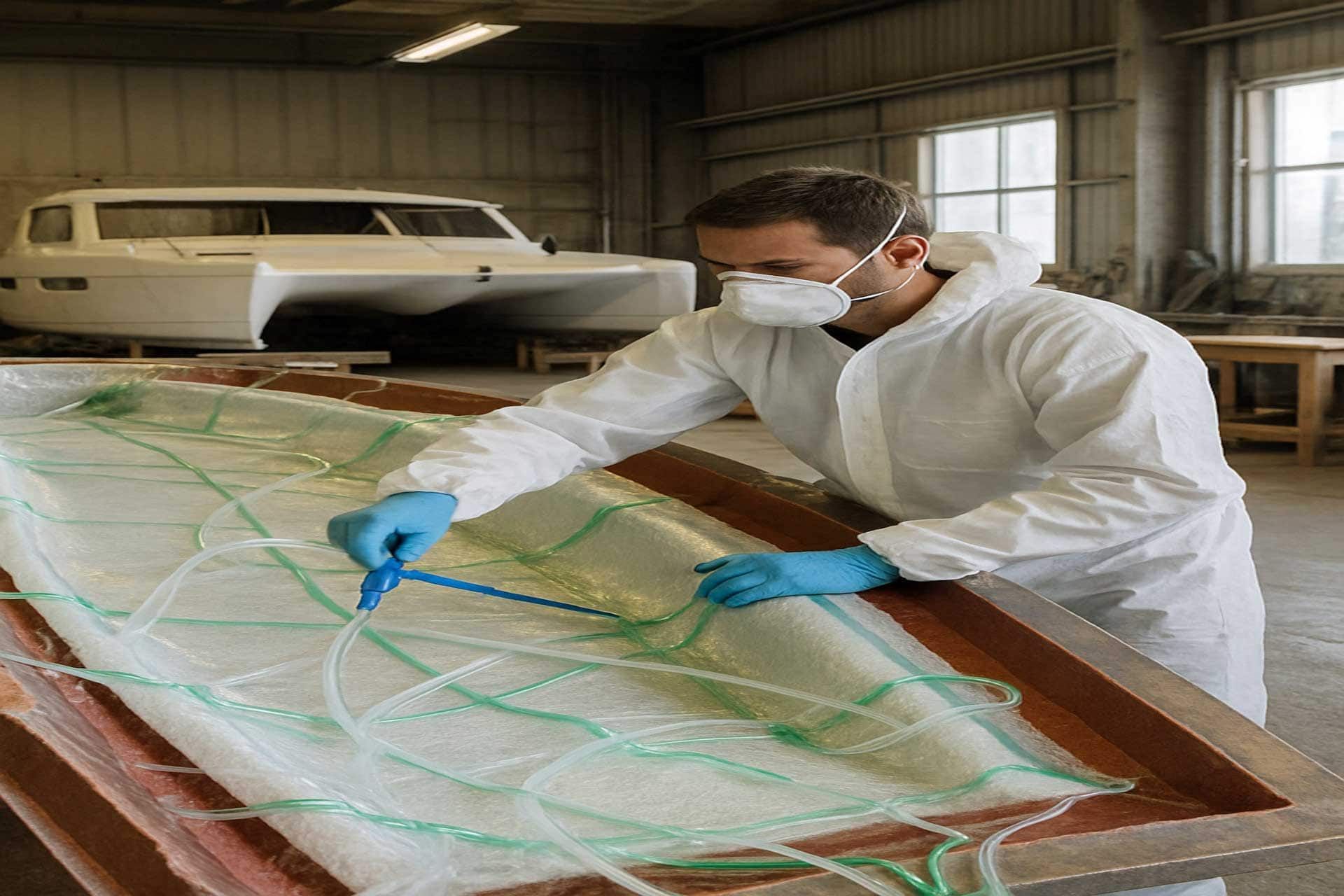
Learn how vacuum infusion technology builds stronger, lighter, and more consistent catamaran hulls compared to outdated hand lamination methods.